
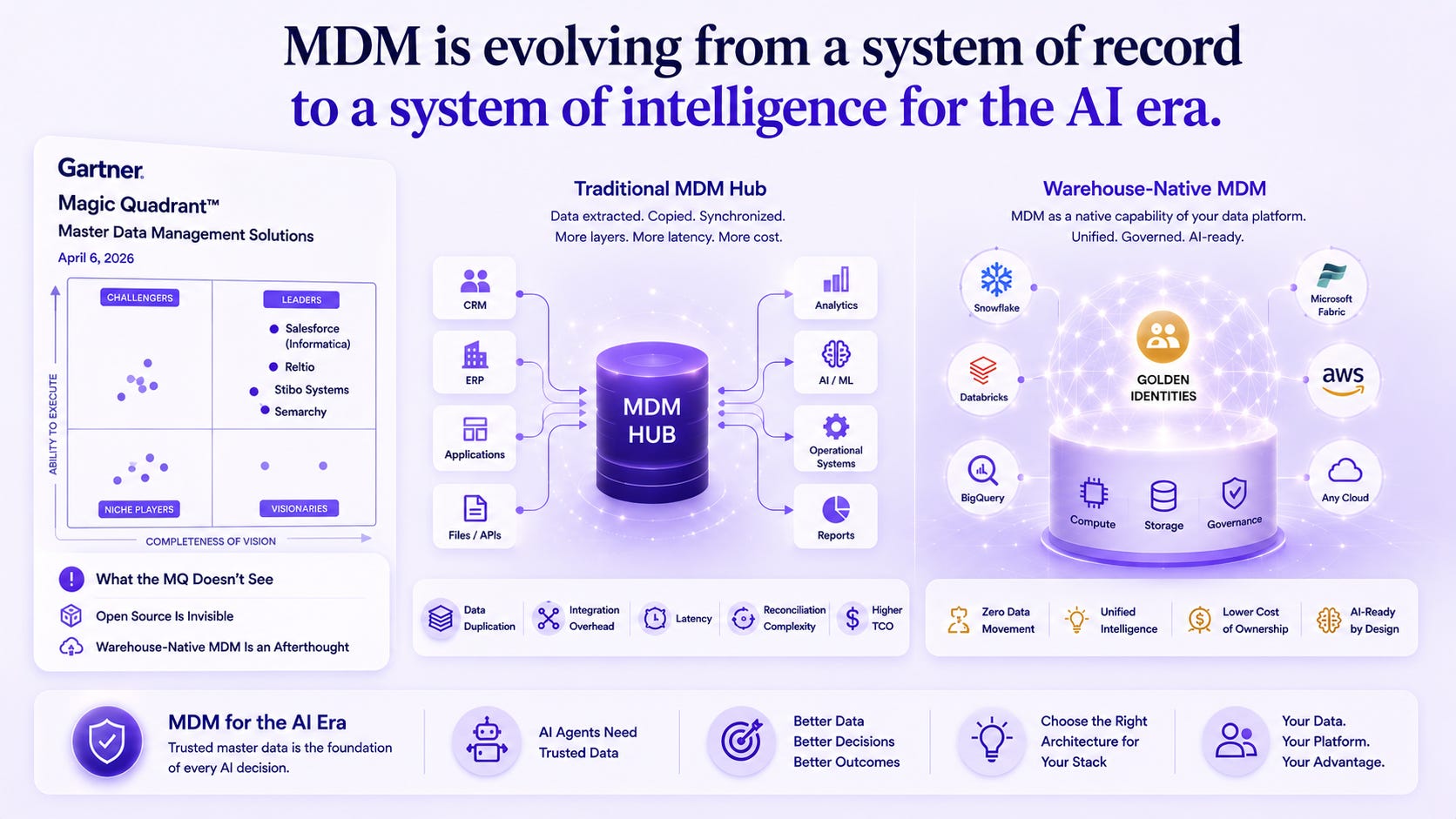
After a four-year absence, Gartner has brought back the Magic Quadrant for Master Data Management Solutions. Published on April 6, 2026, this is the first MDM MQ since Gartner retired it in 2022 — back when it judged the market “stable and mature with little meaningful differentiation among vendors.”
That retirement, in hindsight, was premature. And Gartner essentially admits as much by resurrecting it.
The return is significant. The MDM MQ is the document that shapes enterprise buying decisions, procurement shortlists, and board-level conversations about data strategy. For four years, data leaders evaluating MDM platforms were navigating without it — relying instead on a Market Guide, Gartner’s lower-fidelity fallback for markets it considers less dynamic. The MQ’s return signals that Gartner now sees MDM as a live, competitive, differentiated market again.
They’re right. But the question worth asking is: does the 2026 evaluation fully reflect the market as it exists today?
What Brought It Back
The honest answer is AI. The report itself frames the shift clearly — MDM has evolved from a “static, back-office system of record into a dynamic, real-time system of intelligence essential for the AI era.” When AI agents start acting on enterprise data — making decisions, triggering workflows, serving customers — the quality of the underlying master data becomes existential. Hallucinating AI agents and broken customer experiences trace back to the same root cause: untrustworthy master data.
The rise of the Chief Data and AI Officer has also changed the conversation. CDOs are rejecting monolithic, multi-year implementations in favor of agile, composable solutions. They want master data treated as a data product — governed, reusable, consumable by humans and AI agents alike. That’s a fundamentally different mandate than the MDM world of 2021.
So the MQ is back, evaluating 20 vendors across a framework of Leaders, Challengers, Visionaries, and Niche Players. The Leaders quadrant includes Salesforce (Informatica), Reltio (SAP), Stibo Systems, and Semarchy — credible, enterprise-proven platforms that have been at this for years. The evaluation criteria are thorough: matching and survivorship, multi-domain support, data stewardship workflows, AI augmentation, governance, and integration patterns.
It is a rigorous document. It is also, in two important ways, a document of the world as it was — not entirely as it is.
Gap #1: Open Source Is Invisible
Scan all 20 vendors and their honorable mentions. Not a single open source MDM project is evaluated.
This is not a criticism of Gartner’s methodology — the inclusion criteria require a minimum of 25 production customers, multi-region presence, and a solution that can be deployed without code changes. Open source projects, almost by definition, fail that last test. They are built to be anonymous, downloaded and used in production without the builder knowing about it. Unless they break. Good quality open source products do not break like that.
Unfortunately, the inclusion criteria framing itself reveals something important: the Gartner MDM evaluation is structurally oriented toward commercial, packaged, vendor-managed platforms. The assumption baked into the criteria is that MDM is something you buy, not something you build on top of your existing infrastructure.
For a growing class of data teams — especially those running modern, engineering-led data stacks — that assumption no longer holds. These teams are not looking for another SaaS hub with its own data plane, its own governance layer, and its own license metering model. They are looking for MDM capabilities they can run inside their existing environment, version-control alongside their dbt models, and extend without waiting for a vendor roadmap.
That world exists. It is just not in the quadrant.
Gap #2: Warehouse-Native MDM Is an Afterthought
This is the more structurally significant gap, and it is visible right in the report’s own evaluation criteria.
The mandatory features for inclusion require vendors to create “a central, persisted system of record or index of record for master data.” Optional features — not required, merely nice-to-have — include “medallion architecture support” and “data fabric integration.” Warehouse-native execution, where master data is managed inside the customer’s cloud data platform rather than extracted to a proprietary hub, does not appear as a named evaluation criterion at all.
The logic of warehouse-native MDM is straightforward: your data already lives in Snowflake, Databricks, BigQuery, or Microsoft Fabric. Your transformations run there. Your governance catalog governs it there. Your AI models train on it there. Why should MDM require pulling that data out, copying it into a proprietary hub, and then synchronizing it back — creating a new class of latency, duplication, and reconciliation debt?
The answer, for many modern data teams, is that it shouldn’t. The pattern of warehouse-native MDM — managing master data entities directly within the cloud data platform using the compute, lineage, and governance tooling that’s already there — is the logical extension of the same architectural shift that gave us dbt, Hightouch, and composable data stacks.
The 2026 MQ acknowledges the direction. Stibo Systems earns credit for native integrations with Databricks, Snowflake, and BigQuery. Semarchy’s listing of a Snowflake Native App is called out as a strength. Tamr explicitly earns a caution for deprecating proprietary connectors in favor of an API-first model. The signal is in the details — the market is moving toward the lakehouse, and the vendors that acknowledge this are being rewarded for their vision.
But “integrating with the warehouse” and “running natively inside it” are architecturally very different things. The first still requires an external hub. The second does not.
What This Means for Data Leaders
The 2026 MDM MQ is a valuable document. For organizations evaluating commercial MDM platforms — especially those with complex multi-domain requirements, rich hierarchy management, business-user stewardship workflows, and regulatory audit needs — the Leaders quadrant is a legitimate starting point.
But if you are a data leader running a modern lakehouse or warehouse-first stack, read the MQ as a useful reference for one segment of the market, not a complete map of the terrain.
The terrain also includes a different kind of MDM — one where the matching engine runs inside your Databricks workspace or Snowflake account, where data never leaves your environment, where the model is trained by your team’s domain knowledge through active learning rather than configured through a vendor’s pre-built templates, and where the total cost of ownership is not metered by record count or user seat.
This is exactly the space that Zingg occupies. As an open source, ML-native entity resolution engine built to run on Spark, Snowpark, and every major cloud data platform — Databricks, Snowflake, Microsoft Fabric, GCP, AWS — Zingg represents the architectural thesis that Gartner’s evaluation criteria have not yet fully caught up to: that MDM should be a capability of the warehouse, not a system alongside it.
For the matching, entity resolution, golden ID generation, and survivorship layer — the computational core of what MDM actually does — a warehouse-native, open source engine is not just viable. It is indeed the superior architecture.
The Bigger Picture
Gartner retiring the MDM MQ in 2022 reflected a moment of genuine market stasis. Bringing it back in 2026 reflects something more interesting: a market in genuine motion.
The AI era has made master data strategic in a way it has never quite been before. The quality of the data feeding your AI agents is now a competitive variable. MDM is no longer infrastructure maintenance — it is an AI readiness prerequisite.
That urgency is real and the 2026 MQ captures it well. Where the report leaves room for further conversation is in its definition of what MDM can look like in 2026 — whether it must be a packaged hub or whether it can be a native capability of the platforms where data already lives.
That conversation is worth having. The market is already having it, even if the quadrant hasn’t drawn it yet.
Are you running MDM natively inside your warehouse or lakehouse, or are you still working with a separate hub? I’d love to hear how your team has approached this.