The Context You’re Missing: Why Identity Resolution Is Marketing’s Center of Gravity
Insights from State of Martech 2026

I spent the last two days reading through Scott Brinker and Frans Riemersma’s State of Martech 2026 report. All 112 pages. The metamorphosis metaphor on the cover — the chrysalis transforming a caterpillar into something unrecognizable — turns out to be more than clever design. It’s an accurate description of what’s happening in marketing right now.
But there’s something hiding in that report that deserves more attention than it’s getting. Buried in the discussion of AI agents, agentic workflows, and context engineering is a problem that predates all of this: most organizations still don’t have clean customer identities.
And in the AI era, that’s not just an annoyance. It’s the difference between golden context and garbage context.
The Three-Circle Problem
The report introduces a framework of three overlapping circles representing Company Context, Customer Context, and Systems Context.
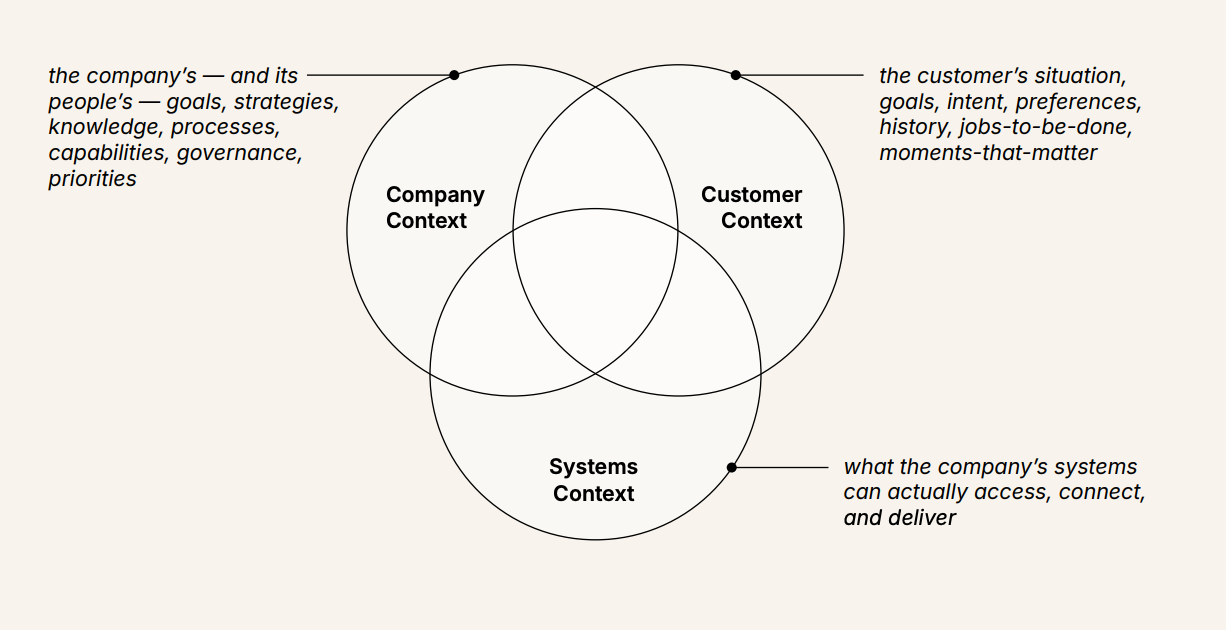
Source: State of Martech 2026, Scott Brinker & Frans Riemersma
Company context is everything you know about your own business — your goals, capabilities, brand voice, governance rules, what you can actually deliver.
Customer context is everything about the customer’s situation — their needs, history, preferences, where they are in their journey, what problem they’re trying to solve right now.
Systems context is what your technology stack can actually access and connect at decision time.
The report calls the overlap between all three circles “Golden Context” — the moment when your company’s capabilities, the customer’s needs, and your systems’ ability to deliver all align perfectly. These are the moments where revenue happens.
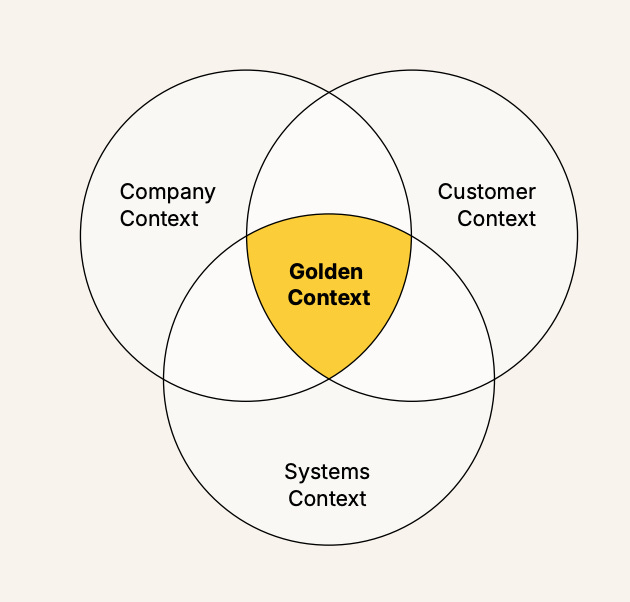
Source: State of Martech 2026, Scott Brinker & Frans Riemersma
You might have deep customer insights somewhere in your data warehouse. You might have a thoughtful segmentation strategy in a deck from last quarter. But if your AI agent can’t access that information when it needs to respond to a customer, you don’t have context. You have documentation.
The Context Stack: Different Layers, Different Speeds
The report also introduces the idea of a context stack with different layers operating at different speeds. Each layer has its own timeline and decay rate.
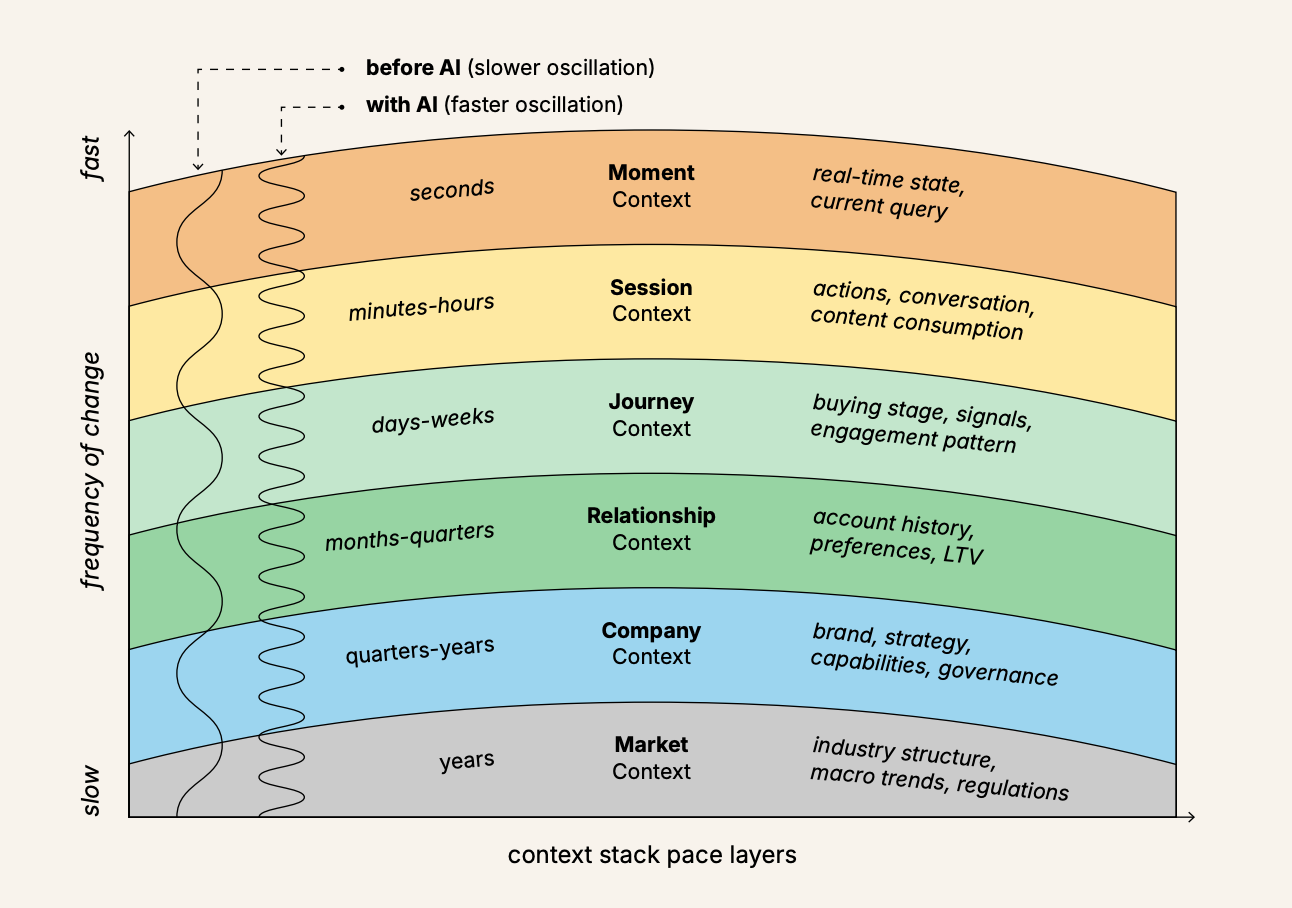
The Context Stack: different layers operating at different speeds. Source: State of Martech 2026, Scott Brinker & Frans Riemersma
At the bottom, market context changes over years — industry structure, regulations, macro trends. Company context shifts over quarters — strategy, capabilities, governance. These are the slow-moving, relatively stable layers.
At the top, the layers move much faster. Journey context changes over days and weeks. Session context over minutes and hours. Moment context in real-time — what someone is doing right now, the question they just asked, the intent signal from this browsing session.
The report’s key insight: the more granular and timely the context, the faster it loses value. That intent signal from this morning? By this afternoon the customer may have moved on, found an alternative, or simply lost interest.
This creates what the report calls a “context distribution problem.” You might have the data somewhere. But if that real-time signal can’t reach the right system before it decays, it becomes worthless.
How Context Reduces Friction
Scott and Frans’ report shows how context transforms customer interactions. The more context an interaction carries, the less work both sides have to do.
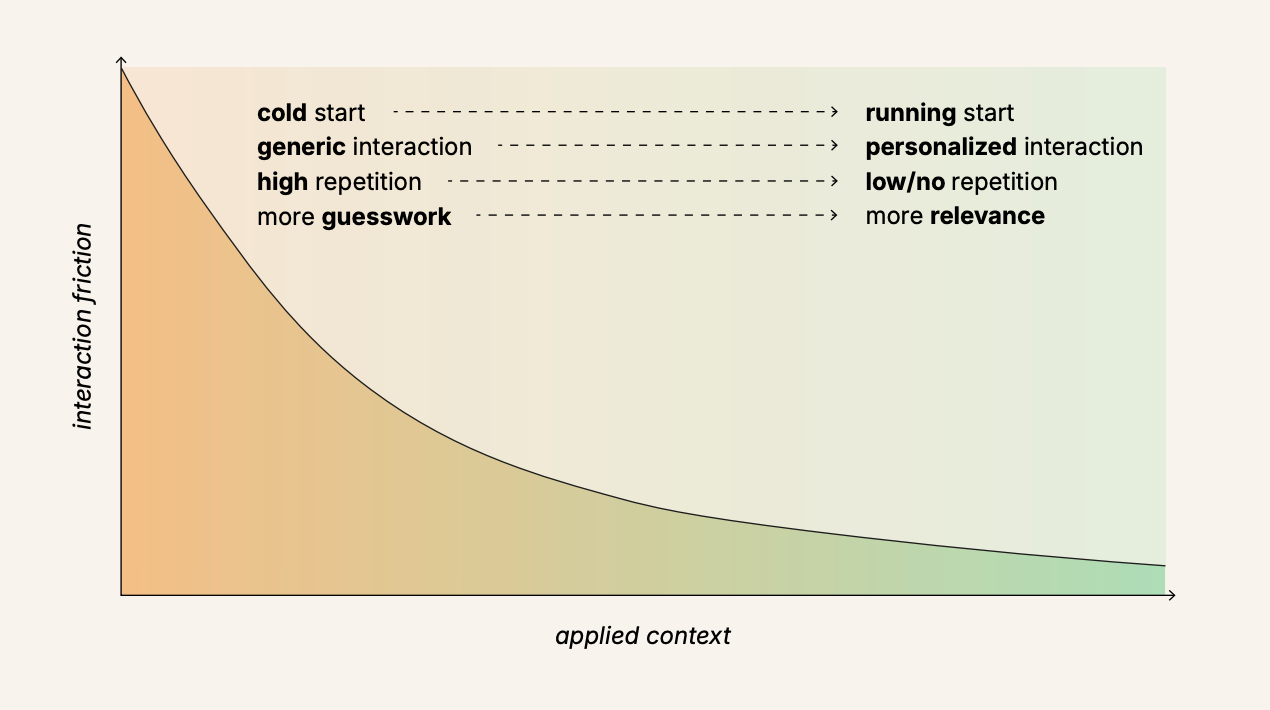
How context reduces friction in customer interactions. Source: State of Martech 2026, Scott Brinker & Frans Riemersma
The curve is convex — the first increments of context eliminate the most friction. Knowing who the customer is and what segment they fall into removes the need to start from scratch. Each additional layer helps: connecting previously siloed information, enriching what you already have, or capturing those fast-moving signals at the top of the stack.
But that curve assumes you’re applying the right context to the right person. When customer identities are fragmented, you’re not reducing friction — you’re creating it at scale.
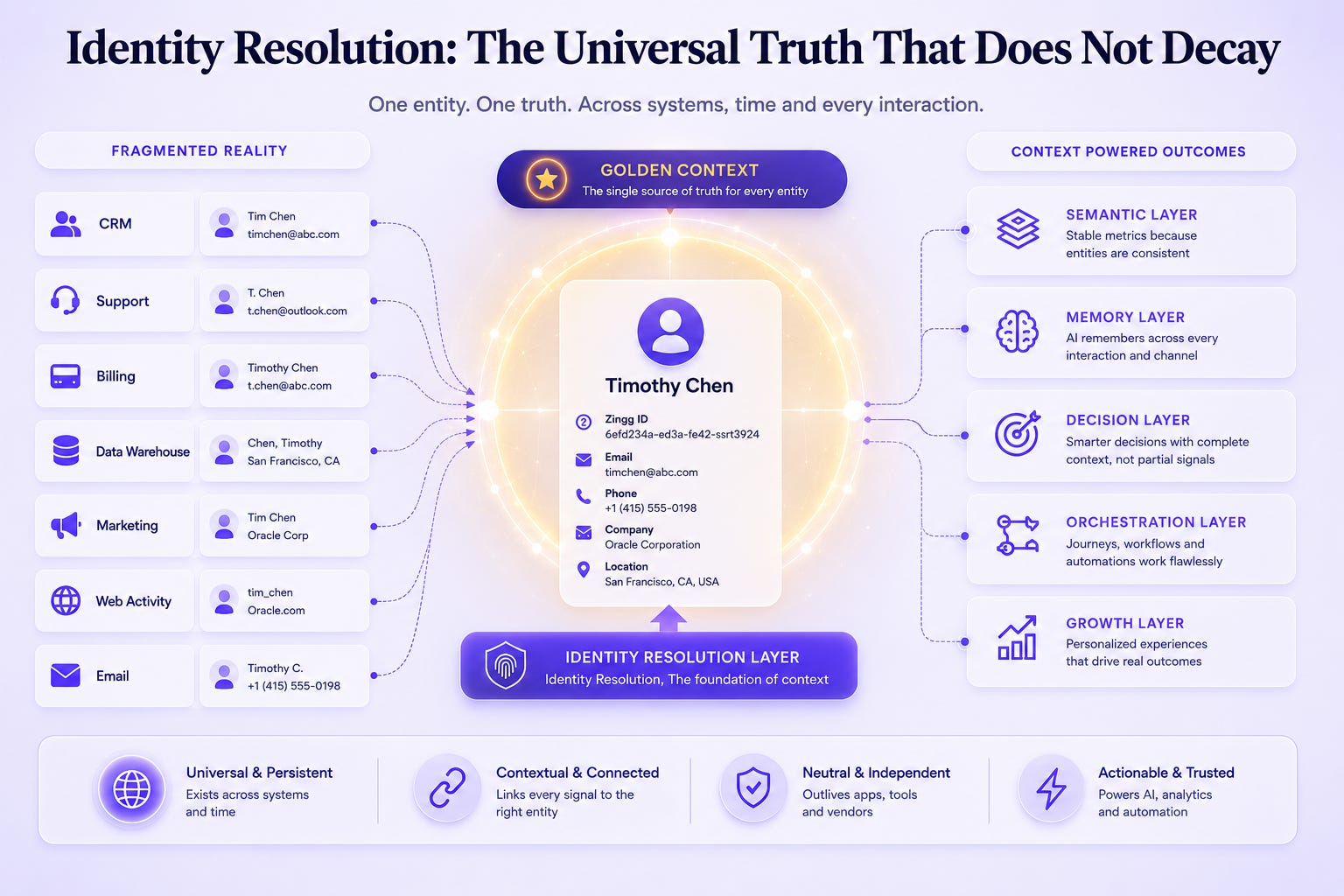
Where Identity Resolution Fits: The Universal Truth That Doesn’t Decay
The report doesn’t focus on identity resolution explicitly. But once you understand the context framework, you realize identity is fundamentally different from every other layer in the stack. Look at the Customer Context circle within the Golden Context. Every piece of information in that circle — purchase history, preferences, journey stage, engagement patterns, support tickets — needs to be tied to the right person. When a customer exists as three separate records across your systems, you don’t have customer context. You have customer fragments.
Those fragments show up everywhere in the context stack and they break every layer of the stack:
In the relationship layer (months to quarters): when account history lives under one identity, recent engagement under another, and support interactions under a third, you can’t build a coherent relationship view.
In the journey layer (days to weeks): when a prospect’s web behavior, email engagement, and sales conversations aren’t connected to the same identity, you can’t tell where they actually are in the buying process.
In the session layer (minutes to hours): when someone browses your site, chats with support, and checks pricing — all in one afternoon — but your systems see three different anonymous visitors, you miss the signal entirely.
In the moment layer (real-time): when an AI agent needs to respond to “what’s the status of my order?” but can’t connect the question to the right customer record, the best it can do is ask clarifying questions that make you look incompetent.
Without that persistent identity thread, you’re constantly starting from cold. Every interaction is generic. Every AI agent makes decisions based on incomplete pictures. Every personalization attempt is a guess.
The report frames context as marketing’s alpha — the competitive advantage that generates excess returns by knowing things your competitors don’t, or connecting what you know faster than they can.
Identity is the foundation of that alpha. It’s the thread that ties all the other context layers together. Market context shifts. Company strategy evolves. Journey signals go stale. Session behavior expires. Moment context has a half-life measured in minutes. But identity persists. The fact that customer A browsing your site right now is the same person who chatted with support yesterday and purchased six months ago — that connection doesn’t decay. Identity is the only context that doesn’t decay.
This is Identity Resolution’s Moment
The report makes the case that AI is dissolving production constraints and revealing context constraints hiding behind them. That pattern applies directly to identity.
For years, the constraint was: can we collect enough data about customers? Marketing teams invested in CDPs, data lakes, customer 360 initiatives. Data volume is no longer the bottleneck for most organizations.
The new constraint is: can we connect that data to the right customer at the right moment?
Traditional marketing automation could limp along with imperfect identities. If you sent an email to the wrong version of a customer record, maybe it didn’t convert, but the damage was contained.
AI agents are different. When they make decisions based on fragmented identities, they create contradictory experiences at scale. An AI-powered shopping assistant recommends products based on incomplete purchase history. A chatbot can’t find the support ticket from last week because it’s filed under a different email. A lead scoring model thinks a loyal customer is a cold prospect because their recent activity is tied to a new cookie.
From conversations with teams, many are discovering a pattern: the AI works fine in testing, then underperforms in production because the underlying customer data is fragmented. The model isn’t broken. The identity foundation is.
The RAG Pattern and Identity
One of the most interesting findings in the report is what they call “RAG Everywhere” — Retrieval-Augmented Generation showing up across marketing in different forms.
Customer service chatbots, sales enablement Q&A, knowledge management, chat-with-data analytics. These look like different use cases, but underneath they’re solving the same problem: retrieve the right context, then generate an accurate response.
The report notes high concurrent buy-and-build activity in these areas because no vendor has completely solved the context retrieval problem.
But retrieval quality depends entirely on identity quality. When a customer asks “what’s the status of my order?” your RAG system needs to identify who is asking, retrieve their order history, apply the right permissions, and generate a response. If step one fails — if you can’t reliably identify the customer — the rest of the chain collapses.
Every RAG implementation in marketing is, at its foundation, an identity resolution challenge.
The Governance Gap
One pattern that shows up repeatedly in the report: AI production adoption is racing ahead while governance lags behind. In Data, coding and automation use cases run at 75–83% adoption while Data Compliance & Governance sits at 50%, Data Lineage at 49%, and Customer Privacy & Consent Management at 47%. The report notes that in Data specifically, governance failures don’t stay contained. Weak lineage and privacy controls infect every downstream agent that depends on that data. A governance gap in data is a governance gap in everything built on top of it.
The report frames this as a budget problem — there’s no immediate ROI story for governance, so it keeps losing the budget fight. But there’s a deeper issue: you can’t govern what you can’t identify.
Data lineage, privacy controls, consent management — all of these require knowing which data belongs to which customer. When customer identities are fragmented, your governance layer has holes regardless of how sophisticated your policies are. If you can’t trace which systems contributed to a customer’s unified profile, you can’t honor deletion requests. If you can’t connect consent preferences to all versions of a customer identity, you can’t enforce them.
What the Martech Landscape Tells Us
What caught my attention in the category-level data: Audience & Identity Resolution sits in an interesting position. It has solid SaaS adoption (48 respondents using AI-native or existing tools), but 57 non-adopters — making it oddly bimodal.
Organizations either have identity resolution through existing CDP, CRM, or ABM platforms, or they don’t have it at all. A meaningful cohort still treats identity as someone else’s problem — owned by sales ops, IT, or data engineering rather than marketing.
The report suggests this structural hesitation may prove costly as AI gets better at fuzzy entity matching and cross-source reconciliation. I think that’s exactly right. The organizations that treat identity as marketing infrastructure — not just a data engineering problem — will have a significant advantage.
Where This Leaves Us
The State of Martech 2026 report makes a compelling case that we’re in the middle of a metamorphosis. The stack is stratifying. AI is everywhere. Context engineering is becoming a distinct discipline. The chrysalis metaphor works because what’s happening inside isn’t gradual improvement. It’s dissolution and reconstruction. The old forms are breaking down. New ones are assembling.
Organizations are investing heavily in the Company Context circle (brand guidelines, knowledge bases) and the Systems Context circle (integrations, APIs, AI tools). That’s necessary work. But they cant leave the Customer Context circle behind. Understanding who your customers are, what they need, where they’ve been, and connecting all that information reliably — this has to be done at an equal footing too.
AI agents need context to be useful. Context needs to be connected to the right customer at the right moment. And that connection — that fundamental ability to say “this data belongs to this person” with confidence — is identity resolution.
The organizations that win in this environment won’t be the ones with the best AI models or the most sophisticated agents. They’ll be the ones with clean customer identities.
This article draws from insights in “State of Martech 2026” by Scott Brinker and Frans Riemersma. All diagrams and frameworks referenced are from their original report. The author has added her perspective to the findings.
The identity resolution challenge isn’t new, but the stakes have changed dramatically with AI. If you’re interested in how we’re approaching this problem at Zingg, you can learn more at zingg.ai.